
How to split trip expenses with friends (without ruining the friendship)
The trip was perfect. The settle-up wasn't. Here's a simple, fair system for splitting group travel costs — uneven spends, different budgets and foreign currencies included — so the only thing your group argues about is where to eat.

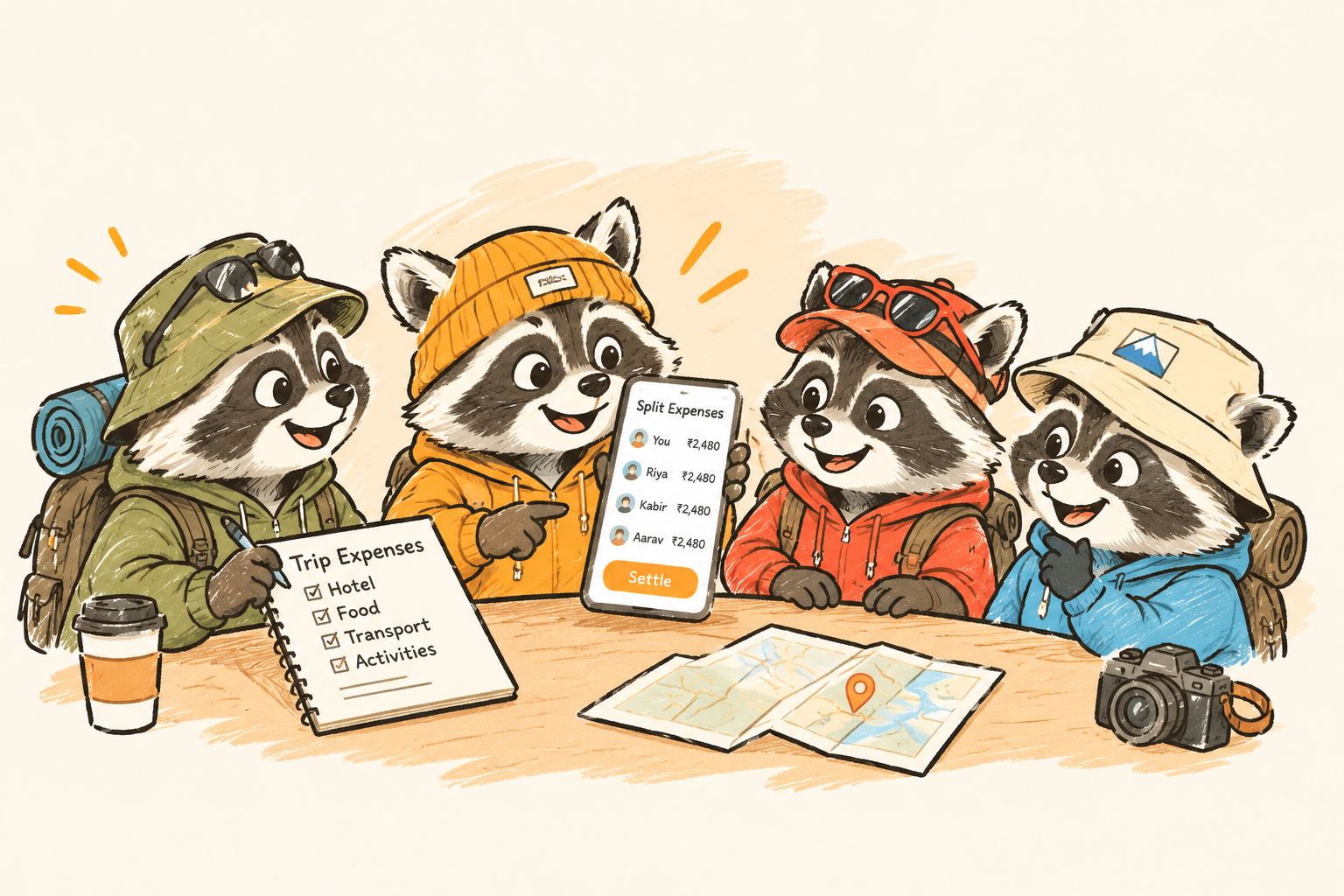
⚡ The short answer
Agree on the rules before anyone pays. Split shared costs — the stay, transport and group activities — equally. Split optional costs only among the people who joined in, and keep personal spends personal. Log every expense the moment it's paid, in the currency it was paid in, then settle once at the end with the fewest possible transfers.
Key takeaways
- Decide the money rules before the first booking. "We agreed on this" ends the arguments that "I thought…" starts.
- Sort every expense into three buckets: Shared (split equally), Selective (split among who used it) and Solo (yours alone).
- Non-drinkers don't pay for the bar tab. People who skip the scuba dive don't pay for it either.
- Log expenses as they happen, in the original currency. Memory is the most expensive accounting system there is.
- Settle with net balances: a group of n people never needs more than n − 1 payments.
- Settle within 48 hours of getting home, while the goodwill is still fresh.
Why does splitting trip expenses get so awkward?
Because most groups never agree on the rules. Everyone carries a slightly different idea of "fair" in their head, and those ideas only collide after the money has been spent.
Look closely at any trip that ended in a passive-aggressive settle-up and you'll find the same five culprits:
- The accidental accountant. One person books the villa, pays for the cabs and fronts the first dinner. By day three they're owed ₹20,000 and feel strange asking for it.
- The non-drinker tax. The bar bill gets split equally, and the friend who had two fresh lime sodas quietly pays for everyone's cocktails.
- Selective memory. Nobody remembers who paid for the airport cab, and everybody's guess flatters themselves.
- Budget mismatch. One friend's "cheap stay" is another friend's monthly rent.
- Currency fog. On an international trip, half the bills are in baht, a few are in rupees, and someone paid on a card with a forex markup. Nobody knows what anything actually cost.
That third one isn't a character flaw — it's wiring. In a classic study, psychologists Michael Ross and Fiore Sicoly asked married partners to estimate their own share of everyday household tasks, and the two partners' estimates routinely added up to more than 100% (Ross & Sicoly, 1979). Your friends will do exactly the same with cab fares.
The good news: these are system problems, not people problems. Fix the system and most of the awkwardness disappears.
What's the fairest way to split travel costs?
Use the 3-bucket method. Sort every expense into Shared, Selective or Solo, and split each bucket its own way. It takes a few seconds per bill and settles most arguments before they start.
Shared
Split equallyCosts everyone benefits from, whether or not they "used" them: the villa or hotel, fuel and tolls, airport transfers, group meals and tickets everyone bought.
Selective
Split among who joinedCosts only some people enjoyed: the bar tab (non-drinkers out), the scuba dive three of you did, the fancy dinner two people skipped.
Solo
Not split at allPersonal spends: souvenirs, your spa session, your third coffee, the jacket you suddenly "needed" in Manali. Pay for it and keep it out of the group maths.
| Expense | Bucket | How to split |
|---|---|---|
| Villa, hotel or hostel (same room type for all) | Shared | Equally |
| Fuel, tolls, cabs and airport transfers | Shared | Equally |
| Group meals everyone ate | Shared | Equally |
| Alcohol and the bar tab | Selective | Only among people who drank |
| Optional activities — scuba, paragliding, a spa day | Selective | Only among people who joined |
| A bigger or private room for one person or couple | Selective | They pay the difference |
| Shopping, souvenirs and personal snacks | Solo | Not split |
The chai rule. Don't log tiny expenses one by one. Anything under about ₹200 — chai, water bottles, a parking slip — goes into a shared kitty, or you simply take turns paying. Tracking every ₹20 turns a holiday into an audit.
Equal split or itemised split: which should you use?
Split equally by default, and switch methods only when participation is clearly uneven. Itemising every bill is technically fairer, but it turns every dinner into a spreadsheet.
| Method | How it works | Best for |
|---|---|---|
| Equal | Total ÷ number of people | Stays, transport, group meals |
| By participants | Total ÷ only the people who joined | Drinks, optional activities |
| By shares | Each person gets a weight — a couple counts as 2, a child as 0.5 | Couples, families, kids |
| Exact amounts | Everyone pays for exactly what they had | Big, uneven bills — like the friend who ordered the ₹3,000 lobster |
| Percentage | Each person pays an agreed share | Groups with very different incomes who've agreed to it openly |
Whatever you choose, run it through the separate-room test: if you asked each person privately whether the split felt fair, would they all say yes? If even one person would hesitate, fix it now. It's far cheaper than fixing it after the trip.
How do you split costs when friends have different budgets?
Plan the trip around the tightest comfortable budget in the group, and make every upgrade optional and self-funded. Nobody should be pushed into overspending, and nobody should be quietly subsidising anyone else.
- Ask for budgets privately. A DM to the organiser or an anonymous form gets honest numbers. A discussion in the group chat gets peer pressure.
- Book to the lowest comfortable number. Choose stays and plans that fit it. Anyone who wants more can upgrade their own experience.
- Price rooms by room when they differ. If one bedroom has the sea-facing balcony, whoever takes it pays a little more — agreed before booking, not argued at check-in.
- Make treats explicit. If someone wants to cover a dinner, wonderful: call it a treat and leave it out of the split. Silent subsidies breed silent resentment.
How do couples, kids and late joiners fit into a group split?
Split by shares and by nights, not just by heads. A couple counts as two people for food and activities, a young child might count as half a share for meals, and anyone who joins late pays only for the nights they were actually there.
Late joiners trip up most groups, so here's the cleanest way to handle them: split each night's cost among the people who slept there that night.
Worked example
Six friends book a Goa villa for four nights at ₹6,000 a night (₹24,000 in total). Five of them stay all four nights. Riya joins for the last two.
- Nights 1–2: ₹12,000 ÷ 5 people = ₹2,400 each
- Nights 3–4: ₹12,000 ÷ 6 people = ₹2,000 each
The five full-stay friends pay ₹4,400 each and Riya pays ₹2,000. That adds up to exactly ₹24,000, and nobody subsidises anybody.
For couples, a per-person split works fine if everyone shares rooms the same way. If the couple gets a private room while everyone else bunks three to a room, agree on a small premium for the privacy upfront. For children, most groups skip charging them for the stay and count them as half a share for meals — whatever you choose, decide it before the trip.
Who should pay upfront for bookings?
Collect money before you book, not after. Ask everyone to send their share of the non-refundable bookings — usually the stay and any flights or trains — before the organiser pays. It protects the organiser and turns "maybe" into "confirmed".
- The organiser shouldn't be a bank. When one person puts ₹48,000 on their card for a villa, they're carrying the whole group's risk for weeks.
- Drop-outs still owe the non-refundable part. Agree on this before anything is booked: if you cancel later, you pay your share of whatever can't be refunded — or you find a replacement.
- Log big bookings the moment they're made, even if the trip is months away, so everyone can see exactly what they owe.
How do you split expenses in different currencies?
Log each expense in the currency it was actually paid in, then convert everything to one home currency at the same rate for everyone. Mixing "what my bank charged" with "what Google said" is how international splits go wrong.
- Log the original amount. A ฿2,400 dinner in Bangkok is ฿2,400 — not a rupee figure someone guessed at the table.
- Agree on one conversion rule. Either use a live market rate for everything (simplest), or use the actual rupees charged to whoever paid (most accurate for them). Pick one before you fly.
- Don't make the payer eat card fees. Many Indian cards add a forex markup of around 2–3.5%, plus GST on that markup. If someone pays a group bill on such a card, reimburse the rupees they were actually charged — or put big shared bills on a low- or zero-markup forex card.
Example: four friends split a ฿2,400 seafood dinner in Bangkok. At an illustrative ₹2.4 to the baht, that's about ₹5,760 — or ₹1,440 each. Log it once as ฿2,400 and let the conversion happen the same way for everyone. Exchange rates move daily, so use the rate on the day.
This is exactly where an app earns its place. Tripbae supports 40+ currencies with live exchange rates: log each bill in baht, dirhams, euros or rupees, and everything rolls up into your home currency automatically. Heading abroad? Our Thailand, Dubai and Japan itineraries each include a full budget in rupees.
How do you settle up with the fewest payments?
Don't settle bill by bill. Work out each person's net balance — what they paid minus their fair share — and have the people who owe pay the people who are owed. Done this way, a group of n people never needs more than n − 1 payments.
Here's how it plays out for four friends back from a long weekend in Goa. Everything was a shared expense, so each person's fair share of the ₹60,000 total is ₹15,000.
| Friend | Paid for | Paid | Fair share | Net balance |
|---|---|---|---|---|
| Aarav | Villa, 3 nights | ₹32,000 | ₹15,000 | +₹17,000 · is owed |
| Diya | Scooters and fuel | ₹8,000 | ₹15,000 | −₹7,000 · owes |
| Kabir | Meals | ₹14,000 | ₹15,000 | −₹1,000 · owes |
| Meera | Boat trip and water sports | ₹6,000 | ₹15,000 | −₹9,000 · owes |
| Total | ₹60,000 | ₹60,000 | ₹0 |
- Meera Aarav ₹9,000
- Diya Aarav ₹7,000
- Kabir Aarav ₹1,000
Three UPI transfers and everyone is square. If the same four friends had settled every bill separately, each of the four big expenses would have needed three repayments — twelve transfers flying in every direction for exactly the same result.
To work it out yourself:
- Add up what each person paid.
- Work out each person's fair share using your three buckets.
- Subtract: paid − fair share. Positive means they're owed money; negative means they owe.
- Have the person who owes the most pay the person who's owed the most, as much as possible. Repeat until everyone is at zero.
Or skip the maths: Tripbae updates balances live as expenses are added and, at the end of the trip, works out the smallest set of payments needed to settle up.
When should you settle — during or after the trip?
Once, within 48 hours of getting home. Settle-ups get harder with every day that passes: receipts vanish, memories blur and small debts start to feel personal. For trips longer than ten days, or when one person has fronted a big booking, add a quick mid-trip checkpoint as well.
The copy-paste money pact for your group chat
The most effective thing you can do takes two minutes: agree on the rules before the trip. Copy this into your group chat, tweak the numbers, and ask everyone to react with a 👍.
📌 TRIP MONEY RULES — react 👍 to agree

1. Stay, transport and group activities → split equally.
2. Drinks and optional activities → split only among people who join.
3. Shopping and personal stuff → your own.
4. Every shared expense goes into the app the moment it's paid.
5. Under ₹200? Don't log it — just take turns paying.
6. Bookings: send your share before we book.
7. Drop out after booking → you still owe your share of anything non-refundable.
8. We settle up within 48 hours of getting home.
What mistakes cause the most money fights on trips?
- Keeping the accounts in one person's head — or one person's Notes app.
- Splitting the bar tab equally between drinkers and non-drinkers.
- Logging expenses "later". Later never comes, and neither does the receipt.
- Rounding in your own favour. Even by ₹10. People notice.
- Letting debts linger for weeks after the trip.
- Mixing personal and group spends on one bill without noting which is which.
- Never deciding what happens if someone drops out.
What should you look for in a trip expense-splitting app?
Pick an app the whole group can use — on Android and iPhone — that logs expenses in any currency with live rates, handles uneven splits, minimises the number of settle-up payments, and doesn't interrupt you with ads every time you add a bill.
- Works for everyone in the group, on Android and iPhone
- Multi-currency, with live exchange rates
- Uneven splits: by participant, by share or by exact amount
- A clear "who pays whom" with the fewest possible transfers
- Fast enough to log a bill in a few seconds
- Budget visibility: what's spent, what's left and where it went
- No ads after every entry
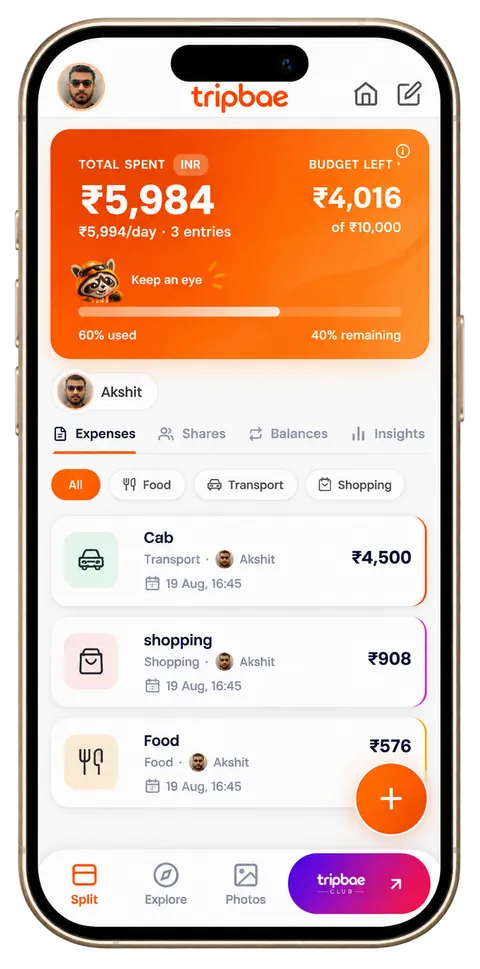
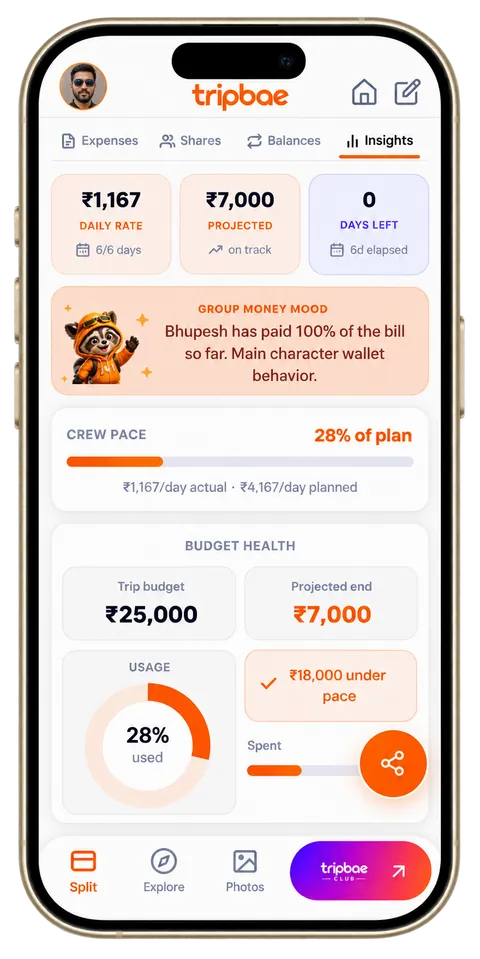
Full disclosure: we built Tripbae because we wanted exactly this list. Splitting in Tripbae is free, with no ads. You log bills in 40+ currencies with live rates, see category breakdowns and a running balance, keep an eye on the budget, and settle up with the fewest possible transfers. And because it's a complete travel app, the same trip also holds your Lumi-built itinerary and a shared photo album.
Frequently asked questions
How do you split trip expenses fairly with friends?
Agree on the rules before the trip. Split shared costs like the stay and transport equally, split optional costs only among the people who took part, and keep personal purchases out of the split. Log every expense as it happens, then settle once at the end using net balances so the group makes as few payments as possible.
Should non-drinkers pay for alcohol on a group trip?
No. Alcohol is a classic selective expense, so split the bar tab only among the people who drank. If food and drinks arrive on one bill, split the food equally and the drinks among the drinkers.
What happens if someone drops out after bookings are made?
The fair, common rule is that they still pay their share of anything non-refundable, usually the stay and pre-booked transport, unless they find a replacement. Agree on this before booking so it never becomes personal.
How do you split a villa or hotel when the rooms are different?
Price by room, not by head. Whoever takes the bigger or better room pays the difference, agreed before booking. If everyone shares rooms the same way, a simple per-person split works.
How do you split expenses on an international trip?
Log every expense in the currency it was paid in, convert everything to one home currency at the same agreed rate, and reimburse card forex markups on group bills. An app with live multi-currency support does the conversion automatically.
How many payments does it take to settle a group trip?
At most one fewer than the number of people. By netting each person's balance, a group of six never needs more than five transfers, no matter how many expenses were logged.
Is it rude to ask friends to pay you back after a trip?
Not if you agreed on a settle-up date in advance. With a rule like "we settle within 48 hours of getting home", asking isn't awkward. It's just following the plan.
What is the best app to split trip expenses with friends?
Choose an app the whole group can use that supports multiple currencies, uneven splits and minimised settle-ups. Tripbae does all of this for free with no ads, and keeps your itinerary and shared photo album in the same trip.
Keep reading

How to plan a group trip with friends (that actually happens)
Dates before destination, deposits before bookings — the 9-step system for getting a trip out of the group chat.
7 days in Bali: the complete itinerary
A day-by-day Bali plan for groups, with a full budget breakdown in rupees.
10 days in Thailand on a budget
Bangkok, Chiang Mai and the islands — with the splits handled.