
How to plan a group trip with friends (that actually happens)
Every friend group has a Goa plan that never left the chat. This is the nine-step system that gets yours from "we should totally go" to the airport — with dates, budget, bookings and money sorted along the way.


⚡ The short answer
To plan a group trip with friends, pick one organiser, lock dates before choosing a destination, and agree on a per-person budget. Then shortlist two or three places, vote once, and collect deposits to confirm who's in. Book transport and stay, build a flexible shared itinerary, and track expenses in one app from day one.
Key takeaways
- Group trips don't die from a lack of excitement. They die from a lack of decisions.
- Dates first, destination second — dates are the real bottleneck.
- A budget is a number, not a vibe. Plan around the tightest comfortable one.
- Two or three options, one vote, one deadline.
- "I'm in" is a mood. A deposit is a decision.
- Plan 60% of the itinerary and leave 40% free.
Why do most group trips never happen?
Group trips rarely die because people don't want to go. They die because nobody makes the decisions that turn a vibe into a booking.
Every friend group has one: the Goa plan. It was first proposed years ago. It has its own WhatsApp group with a palm tree in the name. It has survived three polls, two "guys, this time for real" messages and a beautifully colour-coded spreadsheet that nobody opened.
It has never left the chat.
What kills it is always the same: dates nobody commits to, a budget nobody says out loud, too many destination options, and a headcount that changes every time someone checks their leave balance. The nine steps below remove each of those reasons, one at a time.
How do you plan a group trip with friends? 9 steps
Here's the full process, in the order that works. Each step has one job: remove a reason for the trip to stall.
Pick one trip captain, not a committee
Groups are brilliant at being excited and terrible at making decisions. Give one person the job of running the process: setting deadlines, sharing options, running polls and making bookings.
The captain doesn't get to decide everything. Big calls like the destination and budget go to a vote. But small ones — which of two near-identical homestays, what time to leave — are theirs to make.
Democracy for big decisions. Dictatorship for small ones.
Rotate the role from trip to trip so it never becomes one person's unpaid job.
Lock the dates before the destination
This is the step most groups get backwards. Destination debates are fun; date clashes are fatal. Exams, appraisals, office leave, weddings (it's always wedding season somewhere) — dates are the hardest constraint, so solve them first.
Ask everyone for their blackout dates with a 72-hour deadline, find the window that works, and commit. Long weekends are gold, so check the holiday calendar early and apply for leave before the rest of your office does.
If the dates aren't locked within a week, the trip isn't real yet.
Agree on a budget — as a number
"Something affordable" means ₹8,000 to one friend and ₹40,000 to another. A budget is a number, not a vibe.
Have the captain ask everyone privately for the most they're comfortable spending, all-in, then plan around the lowest number. Decide upfront what the budget covers — travel, stay, food, activities — and agree that shopping and splurges are on each person. We go deeper on this in our guide to splitting trip expenses with friends.
Shortlist two or three destinations, then vote once
With dates and budget locked, the options start narrowing themselves. Shortlist two or three places that fit both — not ten. More choice means more debate, and more debate means no trip.
Use travel time as a filter. A good rule of thumb: the journey shouldn't eat more than about a quarter of the trip.
| Trip length | Travel each way | From Delhi | From Mumbai | From Bengaluru |
|---|---|---|---|---|
| 2–3 days | Up to ~6 hours | Rishikesh, Jaipur | Lonavala, Alibaug | Coorg, Chikmagalur |
| 4–5 days | An overnight train or bus, or a short flight | Manali, Udaipur | Goa, Gokarna | Pondicherry, Hampi |
| A week or more | Almost anywhere | Ladakh, Meghalaya, Kerala, the Andamans — or abroad: Thailand, Bali, Vietnam, Japan | ||
Passports ready but only four or five days? Short-haul abroad works too — Dubai is a 3–4 hour flight from most Indian metros. Here's our 5-day Dubai itinerary.
Then run a single poll with a hard deadline of 24 to 48 hours. Everyone gets two votes, silence counts as "happy with the majority", and the captain breaks ties. One round. No re-votes because someone just saw a reel.
Collect deposits to confirm who's in
This is the step that finally gets the Goa plan out of the chat.
"I'm in" is a mood. A ₹2,000 UPI transfer is a decision.
Ask everyone to send a deposit — ideally their share of the stay — by a fixed date. Whoever pays is in. Whoever doesn't is out, with no hard feelings and the door open until bookings are made. Then lock the headcount: every change after this point reshuffles rooms, cab sizes and per-person costs for everyone else.
Agree on one more rule while you're here: anyone who drops out after booking still owes their share of whatever can't be refunded, unless they find a replacement.
Book the scarcest thing first
For most Indian group trips, that's transport. Indian Railways currently opens most train bookings 60 days before the journey, and popular routes on long weekends go fast. Flights on peak dates only get pricier. Book those, then the stay.
For groups of four or more, villas and homestays often work out cheaper per head than hotel rooms. Before you book one, check:
- Beds, not "guests". "Sleeps 8" sometimes means two people on a sofa bed.
- The bathroom ratio. Aim for one bathroom per two or three people, or every morning becomes a queue.
- Location over luxury. A pool is nice. Being 40 minutes from everything isn't.
- A common space. You'll want one room where everyone can hang out at night.
- The cancellation policy. Flexible beats cheap while plans are still settling.
Build a shared itinerary — plan 60%, leave 40% free
Over-planned group trips feel like school excursions. Under-planned ones turn into four hours of "so what do you guys want to do?". The sweet spot is to plan roughly 60% of each day and leave the rest open.
- One non-negotiable each. Ask every person for the one thing they really want to do. The itinerary guarantees those; everything else is optional.
- One anchor per day — a sunrise trek, a beach day, a fort, a long lunch — with meals sorted and the rest left flexible.
- Allow splits. Early birds can do the sunrise hike while the night owls sleep in. Regroup for lunch.
- Cluster by area so you're not crossing the city three times a day.
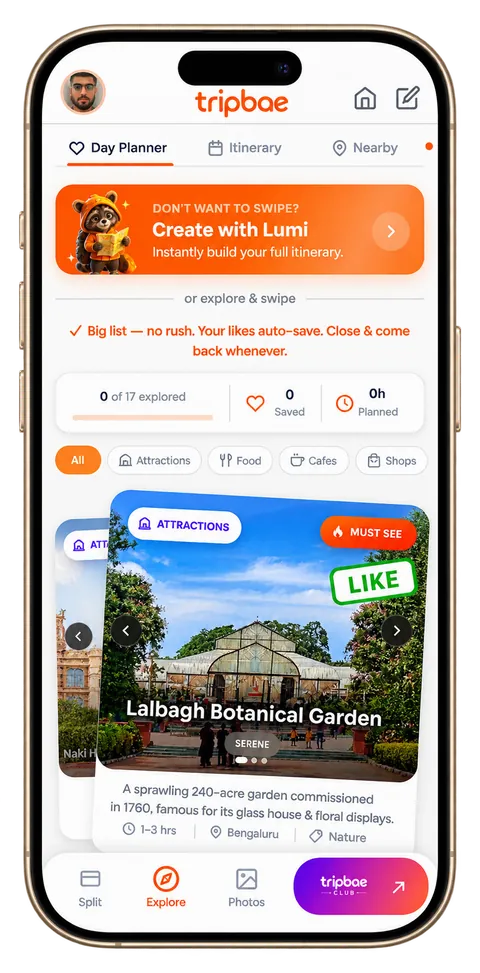
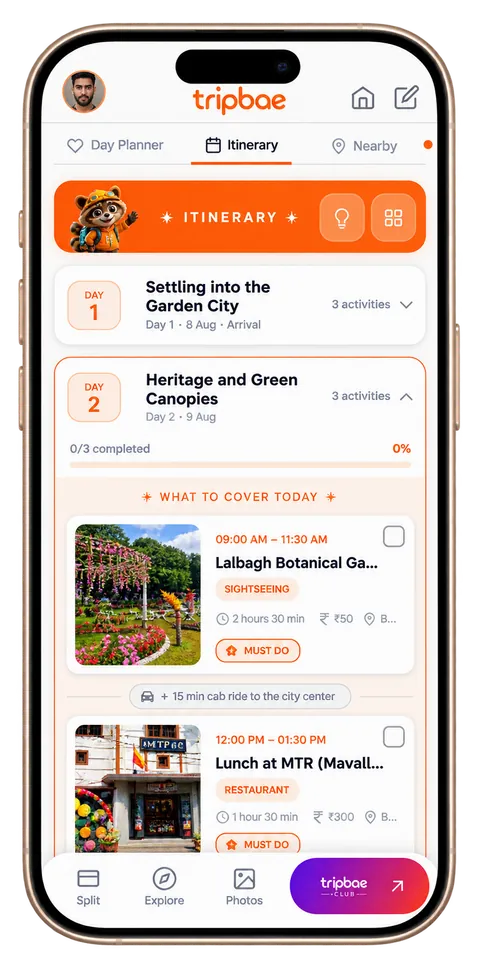
This is the job Lumi, Tripbae's AI travel planner, was built for. Swipe through experiences you like — attractions, cafés, hidden gems — and Lumi turns your picks into a day-by-day itinerary that keeps nearby places together, which you can edit whenever plans change.
Set the money rules before the first payment
Most group-trip fights are money fights in disguise. Before anyone books anything, agree on how costs get split: shared costs equally, optional costs among the people who join, personal spends kept personal — and every expense logged in one place the moment it's paid.
Our full guide covers the method, the maths and a copy-paste "money pact" for your group chat: how to split trip expenses with friends (without ruining the friendship).
Keep one source of truth
Five WhatsApp groups, three screenshots of the same booking and a Google Doc nobody can find. Sound familiar? Put everything in one place everyone can see: dates, addresses, booking confirmations, the itinerary, the expenses and, after the trip, the photos.
In Tripbae, friends join your trip with a code, and the itinerary, expense splits and shared photo album all live inside that one trip — on Android, and on iPhone through the web app.
How far in advance should you plan a group trip?
Start six to eight weeks ahead for a domestic trip, and three to four months ahead for an international one or anything in peak season — December to January, Diwali and the summer holidays. Long weekends book out first, so start those even earlier.
| When | What to get done |
|---|---|
| 8–12 weeks before | Pick a captain, lock the dates, agree on the budget |
| 6–8 weeks before | Vote on the destination, collect deposits, lock the headcount |
| 4–8 weeks before | Book transport (most trains open 60 days ahead), then the stay |
| 2–3 weeks before | Draft the itinerary and book anything with limited slots |
| 1 week before | Confirm the money rules, share documents, download offline maps |
| During the trip | A five-minute morning huddle; log expenses as you go |
| Within 48 hours after | Settle up and share the album |
What's the ideal group size for a trip?
Four to six people is the sweet spot. It fits in one Innova, one villa and one restaurant table, and decisions still happen quickly. Seven to ten works with a strong captain and sub-groups. Beyond ten, treat it like an event, with stricter deadlines and deposits.
| Group size | What it feels like | What you need |
|---|---|---|
| 2–3 | Easy and flexible | Barely any planning |
| 4–6 | The sweet spot | A captain and clear money rules |
| 7–10 | Fun, but slower | Firm deadlines, deposits and sub-groups |
| 10+ | An event, not a trip | All of the above, plus a co-captain |
How do you get friends to actually commit?
Replace open questions with deadlines and defaults. Ask for blackout dates by a fixed time, run one vote with a deadline, make a deposit the definition of "in", and treat silence as agreement with the majority.
- Put a deadline on everything. "Let me know" never ends. "Vote by Friday, 9 pm" does.
- Make silence a decision. Anyone who doesn't respond is happy with the majority.
- Make it real early. One booking confirmation in the chat does more for group energy than ten hype messages.
- Don't chase forever. If someone has missed two deadlines, plan without them and keep the door open.
How do you handle different travel styles in one group?
Give everyone one non-negotiable, plan one shared anchor a day, and make it normal to split up for a few hours. You don't have to do everything together to have the trip together.
| The clash | The fix |
|---|---|
| Early birds vs night owls | Morning plans for the early birds; everyone regroups at lunch |
| Planners vs go-with-the-flow | The 60/40 rule — anchors planned, the rest left open |
| Budget vs splurge | Plan to the tightest budget; upgrades are optional and self-funded |
| Foodies vs "anything is fine" | The foodies pick the dinners; everyone else picks the plans |
| Party people vs early nights | Split the evening — one crew heads out, the other keeps the villa |
Group trip planning checklist
Tick these off and your trip is ready to leave the chat.
Before booking
Bookings
Before you leave
During and after
Frequently asked questions
How do you plan a group trip with friends?
Choose one organiser, lock dates first, agree on a per-person budget, shortlist two or three destinations and vote once. Then collect deposits to confirm who's going, book transport and stay, build a flexible itinerary, agree on money rules, and keep everything in one shared app.
How far in advance should you plan a group trip?
About six to eight weeks ahead for a domestic trip and three to four months for an international trip or peak dates such as December to January, Diwali and the summer holidays. Long weekends book out first, so start earlier for those.
How do you get friends to commit to a trip?
Put a deadline on every decision and ask for a deposit. Once someone has paid their share of the stay, they're in. Treat silence as agreement with the majority so one slow responder can't stall the whole group.
What is the ideal group size for a trip?
Four to six people. It fits in one car, one villa and one restaurant table, and decisions stay quick. Bigger groups work with a strong organiser, firm deadlines and sub-groups.
How do you choose a destination everyone agrees on?
Filter by dates and budget first, shortlist only two or three places that fit both, then run one vote with a 24 to 48 hour deadline. Give everyone two votes and let the organiser break ties.
How do you split costs on a group trip?
Split shared costs like the stay and transport equally, split optional costs only among the people who join, and keep personal spends separate. Log expenses as they happen and settle once at the end using net balances.
What's the best app for planning a group trip?
Look for one app that keeps the itinerary, expenses and photos together, so nothing lives in scattered chats. Tripbae does this for free: its AI planner Lumi builds the itinerary, expenses split across 40+ currencies, and the whole group shares one album.
Keep reading
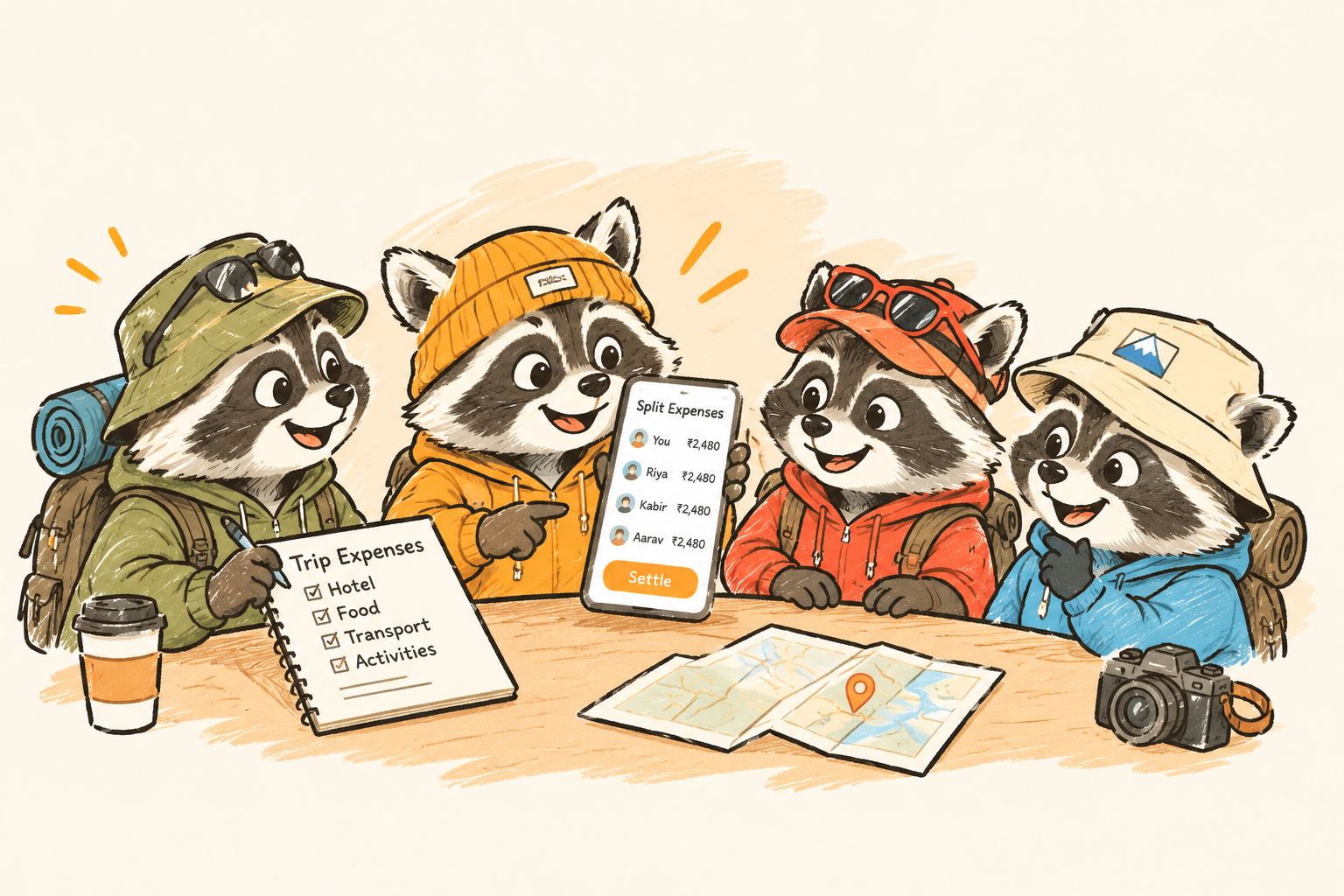
How to split trip expenses with friends (without ruining the friendship)
The 3-bucket method, multi-currency splits and settling up in the fewest payments.
5 days in Goa: North vs South
Beaches, shacks, heritage and the spots the tourist trail misses.
7 days in Bali: the complete itinerary
A day-by-day Bali plan for groups, with a full budget breakdown in rupees.